Programme notes by Helen Simpson, Guy Richardson and Chris Darwin
Ludwig van Beethoven (1770-1827)
Trio in G for Flute, Bassoon and Piano WoO 37 (c.1786)
Allegro
Adagio
Thema Andante con Variazioni
In case you’re wondering what on earth WoO stands for, it is Werke ohne Opuszahl ( works without opus number). Beethoven’s unpublished works or those to which he gave no opus number were listed in a catalogue prepared in 1955 by Georg Kinsky a German musicologist and completed after the latter’s death by Hans Halm, a State Music librarian.
This Trio was written probably in 1786 when Beethoven was only 15 and was found amongst his papers after his death and then published. It was written for Count von Westerholt who played bassoon, his pianist daughter to whom Beethoven was giving lessons, and his son who played flute, so very much a family occasion!
The first movement opens with a falling octave and the announcement of the first theme. This is followed by the second theme on piano featuring offbeat rhythms, something Beethoven would develop in his mature works with thrilling and dynamic effect, anticipating the rhythms of jazz and later rock music.
The development features a striking move into the minor and a pensive passage on the bassoon leads into the recapitulation. A decisive cadence closes the movement.
The bassoon states the gentle theme of the Adagio. Triplet rhythms lead into a beautifully modulating passage, and in a mysterious transition, with long pensive notes on the bassoon and a arpeggio on the piano, we are led into the third movement.
The cheerful theme undergoes seven variations : the first features offbeat rhythms starting delicately and becoming more robust. The second is marked by fast triplets on the bassoon, followed by the third with rather march like dotted figures on the flute and piano. The fourth again focuses on the bassoon with its flowing triplets and piano accompaniment. Fast semiquavers open the fifth, piano dominating, then leading into light and graceful staccato notes on the flute. The sixth again has a march like feel and carefree mood, while in the seventh we hear the theme return in its original form but now faster. This leads to a short coda, featuring delightful flourishes on the piano.
Claude Debussy (1862-1918)
Syrinx for solo Flute (1913)
As a child growing up in Paris Debussy had a somewhat unsettling time in the period of the Commune of 1871 when his father was imprisoned for revolutionary activities. However his music education gave Debussy purpose and early success as a pianist. His studies in music theory and composition soon overtook the Piano in importance and in 1883, aged 19 years he won the second Prix de Rome in composition.
Syrinx was written as incidental music to be played off-stage in “Psyche” a play by Gabriel Mourey. The free style of the flute solo portrays the pursuit of the nymph Syrinx by the God Pan. Syrinx in an effort to escape from Pan’s attention turns herself into a water reed. Pan cuts some reeds to make them into a set of pipes, thus killing his love. Originally the piece was called Flute de Pan . In 1927 it was finally published and named Syrinx.
Syrinx is a late piece in Debussy’s life, written only 5 years before his death. It is unconstrained by conventions of structure, tonality and rhythm and though it is notated in the standard way the listener’s impression is of a fluid, chromatic and emotionally charged piece. It could be improvised for all we know, if it was played off-stage as originally conceived. The chromatic quality destroys any clear tonality and in the 35 bars the emphasis is on whole tone scalic movement rather than major or minor tonality. The opening note Bb is the most important pitch, repeated frequently in two registers and often at the top of a falling sinuous phrase moving to Ab and Gb hence the “whole tone” identification.
This very short atmospheric and seemingly wayward piece works its way lower and lower in pitch and comes to an end with a final whole tone scale from B natural to Db. This is at the lower end of the Flute’s compass and demonstrates a very different colour from the opening phrase.
Poulenc Flute sonata programme note
Francis Poulenc (1899 – 1963)
Flute Sonata (1957)
Allegro malincolico
Cantilena: Assez lent
Presto giocoso
Poulenc came from two very contrasting backgrounds: that of the pious Roman Catholic family of his father, who was joint owner of a successful firm which manufactured pharmaceuticals, and that of his mother, a pianist and whose family had wide artistic interests. Poulenc attributed the contrasts in his nature to this background, and the critic Claude Rostand described him as ” half monk and half naughty boy”!
His father refused to let him attend a music college and so he received a conventional school education. His main musical education came from his piano teacher Ricardo Vines and later composer colleagues like Georges Auric and Erik Satie.
Poulenc wrote this sonata shortly after finishing his opera ‘Dialogues des Carmélites’. It was a commission from the Elizabeth Sprague Coolidge Foundation and dedicated to the memory of this remarkable woman (she died in 1953), who as well as being an accomplishes pianist, was a patron of chamber music and helped establish its status in America, where orchestral music ruled. Her many commissions included Bartok’s 5th String Quartet and Britten’s Ist.
Poulenc’s sonata was written for the flautist Jean-Pierre Rampal, to whom he said in relation to the commission ‘ I never knew her, so I think the piece is yours’. With the composer on the piano, they gave the first performance in June 1957 at the Strasbourg Music Festival.
The little flourish on the flute that opens the sonata becomes a crucial motif throughout the piece. After some development of the opening theme, complete with Poulenc’s characteristic and delightful shifts of harmony, the piano introduces a contrasting slower section in a sterner mood. The opening returns, and after a new variation, the music calms down, preparing us for the central movement.
This opens with a serene and beautiful melody on the flute. After a more dramatic central section building to a climax, the opening theme returns, now calmer.
The Presto opens in a lively and playful mood, leading into a more lyrical theme and teasing hints of the motif we heard right at the beginning of the piece. After a dramatic pause and a moment of quiet reflection, the opening of the movement steals in and leads to a brief coda.
Henri Dutilleux (1916-2013)
Sarabande et Cortège for Bassoon and Piano (1942)
Assez lent
Mouvement de marche
Dutilleux , who came from a very artistic and musical background, studied at the Douai Conservatory near Lille and then the Paris Conservatoire. He didn’t write a large number of works, being severely self-critical, but these include two symphonies, a concerto for cello and one for violin, some chamber works, pieces for piano, some vocal works, a ballet and some film scores.
He followed his own individual path and refused to be associated with any school of composers. He was very critical of the more radical developments in music such as serialism and rejected the dogma and authoritarianism associated with it. For this he was looked down on by the snobbish avant-garde and figures like Pierre Boulez refused to perform his works!
His own interests were wide and varied and some of his works reflect his interest in jazz and the world of art – his orchestral piece for example ‘Timbres, espaces’ was inspired by Van Gogh’s ‘Starry Night’.
The Sarabande et Courtège was written as the first of a series of exam pieces he wrote for the Paris Conservatoire between 1942-50.
The Sarabande ( defined as a slow stately dance in triple time) marked Assez lent, opens with a gentle steady paced theme. The tempo speeds up leading to a short bassoon cadenza, which in turn leads into a variation and development of the opening music.
After a brief silence we launch straight into the Courtège, marked Mouvement de marche. This is definitely not a funereal procession but one in an almost jaunty and slightly jazzy mood with a staccato bass figure on the piano and some swung rhythms on the bassoon. We arrive at a long cadenza on the bassoon marked ‘freely’, which begins slowly and gradually speeds up, leading to a very high note and the dramatic concluding bars.
Carl Maria von Weber (1786-1826)
Trio in G minor, Op.63 for flute, bassoon and piano (1819)
Allegro moderato
Scherzo: Allegro vivace
Shepherd’s lament: Andante espressivo
Finale: Allegro
Weber’s musician father had ambitions for his son to match the achievements of the husband of Constanza Weber, Carl’s cousin. Though no Mozart, Carl Weber had an extensive and diverse influence over musical life at the start of the Romantic period. Wagner, Liszt, Mendelssohn, Mahler, Glinka, Stravinsky, Berlioz and Debussy admired his orchestral and operatic writing, and, as a conductor, he introduced sectional rehearsals and transformed the conductor’s role from mere time-beater to one who moulds the performance. His huge hands helped him become a formidable pianist, and some of his chords “cannot be played by normal human beings” (Harold Schonberg).
As a composer, he was precocious: an opera he wrote aged 14 was produced in Freiburg, Vienna, Prague, and Saint Petersburg, and four years later in 1804 he was appointed Director of the Breslau Opera. He was frustrated by his inability to reform that institution, and in 1806 while recuperating from an accidental dose of “engraver’s” (nitric) acid, he saw his reforms set aside and he resigned. He became private secretary to the king’s brother in Württemberg. There his father embezzled huge sums and Carl himself fell heavily into debt; they were both imprisoned and then banished. Undeterred he became director of the Prague theatre, successfully carrying out there his previously-frustrated anti-Italian reforms. In 1817 he moved to the Dresden theatre as director of the German repertoire (someone else did the Italian) and stayed there for the rest of his life.
Today’s trio was composed in the early years at Dresden as he was starting to compose his best known work, the opera Der Freischütz. The trio was originally written for piano, flute and cello, probably in memory of convivial musical evenings in Prague with a couple of flute- and cello- playing friends. An inauthentic substitution of violin for flute followed after Weber’s death, but the substitution of bassoon for cello is relatively recent.
The title of the third movement – The Shepherd’s Lament – alludes to a 1802 poem by Goethe that was frequently set to music. The actual theme that Weber uses (illustrated) is lifted from a song written in 1802 by a minor composer Wilhelm Ehlers. The Finale contains at least two allusions to motifs in Der Freischutz.
See Chris Darwin’s Programme Notes for other works on his web page.

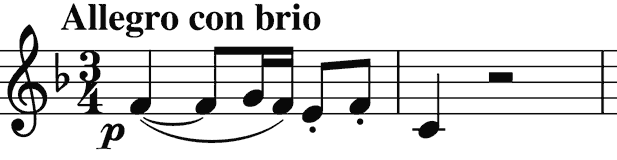


 an earlier String Trio (Op 9 no 3 Presto; illustrated), and, like the opening of this quartet’s first movement, provide an easily recognisable motif for the listener as Beethoven plies us with fugal flourishes.
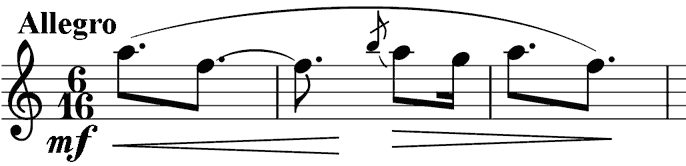 string quartet, was written around the same time as these operas, and shares with them the technique of shaping individual phrases to the prosody of the speaking voice. The opening phrase captures the phrase ‘Mládí, zlaté mládí!’ (‘Youth, golden youth!’) and recurs throughout the work especially in the first and last movements.
 work Janáček composed earlier in 1924 for piccolo, bells and tambourine ‘March of the Blue Boys’, recalling his time as a chorister in the Old Brno Monastery.
 with a sighing, falling fifth (*, illustrated). It sets the mood and also opens the main Allegro and recurs throughout it in various guises. Schumann’s rhythmic trickery pops up in the second subject
 of the Allegro (illustrated). After a brief silence, the upper strings start their off-beat accompaniment just before the cello enters with the theme. Not only is this deceptive for the listener, but it is a notorious pratfall for the unwary amateur player.
 (illustrated). Here everyone enters on the last quaver of the bar, but the tune is tied over as if the first note were really the downbeat. The theme is a decorated descent over an interval of a fifth. There follows a set of entertaining variations culminating in one of huge and relentless energy with the accent resolutely on the offbeat, dominated by leaps that rework the opening falling fifth. A calming coda prepares us for the beautiful Adagio molto
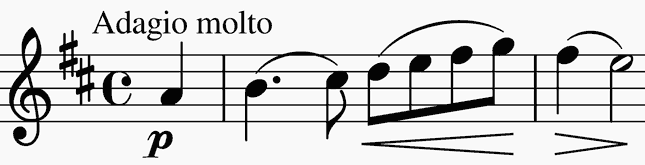 (illustrated), whose opening theme is based on a rising figure that again embraces an interval of a fifth. The serenity of this idea is twice challenged by a threatening transformation in the minor, but serenity prevails.
 is a sequence of ‘laconic phrases until the lilting expansive cadence of its final bars’ (Rosemary Hughes). Notice that each of the illustrated four initial phrases contains three notes of a rising scale. This scale motif is central to the whole quartet. Three variations at the leisurely Allegretto tempo follow before the starting gate is raised on an Allegro fugue which then metamorphoses into a final variation.
 Unlike Mozart who rarely strayed outside key signatures of 3 sharps or flats, Haydn was given to writing in lots of them. This movement is really in B major – 5 sharps, but it starts (illustrated) with no key signature albeit with the notes liberally sprinkled with sharps. Was this a riposte to complaints from his players about dreadful keys, or is the lack of key signature granting him licence for his upcoming fantastic explorations of the key-space? These explorations are facilitated by a series of four rising scales (echoing both the start of this movement and of the first movement) first on the violin and then on the cello. They lead the music off all around the block to Ab before a second lot of cello scales brings us home to B major and a proper key signature. The second half gives us a serene and poignant development of the theme.
 Four falling scales also make up the theme of the spirited final movement (illustrated).
 Dutilleux’s sound-world builds on his compatriots Debussy, Ravel and Messiaen but also includes Bartók and Stravinsky, with a preference for the modal and atonal over the simple tonal. Many of the quartet’s intriguing sounds are based on the opening six-note chord (illustrated) which particularly contains the intervals of the fifth (C#-G#, F-C) and the second (F-G, C-D). The seven short movements explore different string techniques: pizzicato, glissando, harmonics, very high and very low, very quiet and very loud. Dutilleux, like Sibelius, has in his own words “a tendency not to present the theme in its definitive state at the beginning. There are small cells which develop bit by bit”. So, see what you think and do talk about it in the interval.
 (G#-A, E-F) in the cello’s opening phrase (illustrated), which is joined by the other three instruments playing variants of the same motif. This slow introduction is broken by rapid semiquavers from the first violin leading into an important motif (illustrated) which starts with one of the opening’s semitone pairs (E-F).
 The dotted rhythm (under y) provides a rhythmic engine to the movement and ends with the other semitone pair (G#-A).
 with the lines of a hymn (under x) interleaved by faster moving phrases. After the hymn, there is a dramatic change to the optimism of D major for a faster variation section marked “New Strength” in which the two violins dance around each other. A more syncopated version of the hymn returns followed again by a variation and finally by a yet more syncopated fantasia on the hymn marked “with the most intimate feeling”. The convalescent falls asleep with gentle sighs…
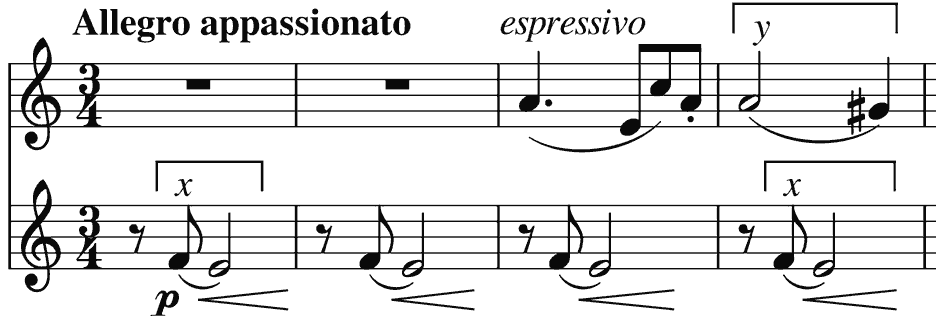 to the first violin’s restless theme with its G#-A semitone (under y). A gentler theme with decorative trills brings some hope, but wild cross-rhythms augment the tension culminating in an anguished outburst high on the cello as the tempo hits Presto. But the key then shifts to a radiant A major, and the quartet ends in a mood of joyful optimism.