

15th March 2026 – Regency Quartet – Programme notes
Wolfgang Amadeus Mozart (1756–1791)
String Quartet in C major K.465 (Dissonance) (1785)
Adagio – Allegro
Andante cantabile
Menuetto & Trio – Allegro
Allegro
Mozart’s “Dissonant” quartet is the last of the famous set of six quartets that Mozart dedicated to Haydn – the A major K.464 from this set was played earlier this season by the Chilingirian Quartet. The set was inspired by Haydn’s six Op 33 quartets that had appeared in 1782, encouraging Mozart to a “long and laborious study” which eventually gave birth (between 1782 and 1785) to these “six sons”. This last quartet of the six is the best known and, like the A major quartet, demonstrates how much Mozart had learned during his long study.
The Dissonant epithet refers to the extraordinary opening bars.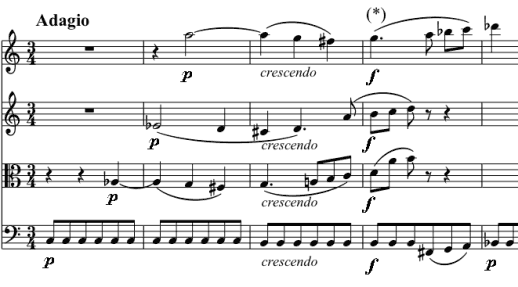 The cello at first gives nothing away, pulsing on the tonic of the innocuous home key of C major. The viola enters on an Ab and the second violin on an Eb, making an Ab major chord and then the first violin comes in a semitone too high on an A natural just as the viola drops from Ab to G, leaving us in C minor with an added (A) sixth, and we haven’t finished the second bar yet! Even to our 21st–century ears it surprises. No wonder some early commentators suggested that Mozart’s text contained uncorrected errors. These few bars provide source material for the whole quartet: the pulsing base, staggered entries, semitone clashes and a sliding rising figure (*).
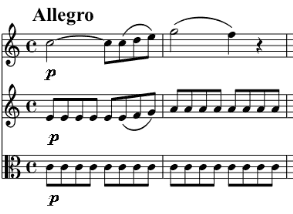 For example, the solidly C-major opening phrase of the Allegro is a non-chromatic version of this rising figure, together with the pulsing base. Mozart uses this figure to lead us into yet more wonderfully remote keys in the development section.
The Andante opens with a tender theme on the first violin, whose ending becomes a simple little figure that the violin repeats and is each time lovingly echoed by the cello.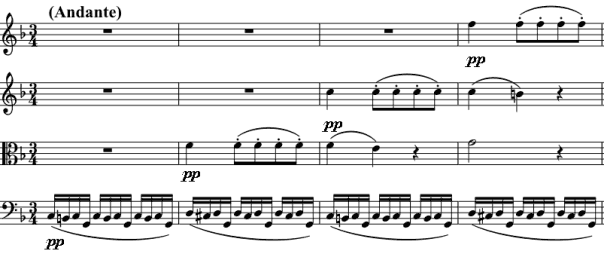 There is then a magic pianissimo passage that, like the introduction, has a gradual build–up of instruments above the moving cello, but without its challenging dissonances. But just wait; when this passage returns shortly before the end of the movement, it crescendos to forte as the first violin produces a striking semitone dissonance like the one we heard in the introduction.
The Menuetto is based on the chromatic sliding quavers that the first violin opens the movement with and which are also based on the asterisked (*) figure in the first musical example. The Trio though starting piano is in an irate C minor, with incessant accompanying repeated quavers and forte outbursts. The sun returns in the last movement, whose opening theme again includes those rising, sliding semitones. All the instruments enjoy the contrapuntal fun of this movement, and then as the piece is ending, the coda shows us, as in so many of Mozart’s works, just a few of the other things he could have done with this material.
One of the joys of playing this set of quartets for a violinist / violist is to take a different inner part of a quartet that you thought you knew well, and discover the exquisite detail that Mozart produced in his “long and laborious study”. As you listen to this piece try following one of the inner parts and hear why string players are so grateful to Haydn for stimulating Mozart to write these quartets!
Notes by Chris Darwin
Jessica Montgomery (b. 1981)
Strum
Born in Manhattan, New York to a playwright and actor mother and composer and filmmaker father, Jessica Montgomery studied violin from a young age and wrote her first piece at around eleven years old.
She spent her early career as a performer and teacher and working in community groups.
Her compositions reflect a broad range of cultural influences, including folksongs, protest songs and dance music from around the world.
She has written for a wide range of ensembles, including for orchestra, chamber groups, choral and vocal works and for band and wind instruments.
Strum was originally written for cello quintet in 2006 but was revised and arranged for string quartet in 2008 and then further revised in 2012.
Montgomery says the piece draws on ‘ American folk idioms and the spirit of dance and movement’.
It’s a fairly short piece, around seven and a half minutes, but a thoroughly exhilarating ride, and after one brief moment of quiet contemplation, the tempo and excitement gradually builds unto the end.
Notes by Guy Richardson
Anton von Webern (1883–1945)
Langsamer Satz (1905)
Webern was only 22 when he wrote this Slow Movement; it is a 10-minute late romantic treat reminiscent of Schönberg’s Verklärte Nacht written 6 years earlier.
As a child Anton von Webern (his parents were minor aristocrats and he only dropped the ‘von‘ following an edict from the Austrian state in 1915) studied cello and piano. His first compositions were settings of songs, but while a music student at the University of Vienna between 1902 and 1906 he also composed various instrumental pieces including tonight‘s Langsamer Satz and also another longer single movement work, now known as his String Quartet. In 1904, he answered an advertisement placed by the short–of-work Schönberg inviting composition pupils. Schönberg was to become the most important influence on Webern’s life – his admiration bordered on infatuation. In the 1920s Webern became a more punctilious practitioner of Schönberg‘s 12-tone system than the master himself. But in 1905 such duodecanal rigours were unheard of, and master and pupil merely pushed provocatively on the constraints of tonality.
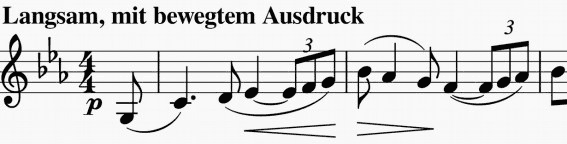 Tonally Langsamer Satz is a simple sandwich: Eb bread with a C filling – the rising triplets of the opening Eb melody (illustrated) contrasting with falling in the filling (illustrated).
 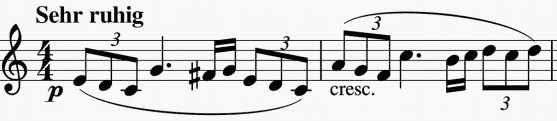 The languid, expansive feel to this work gives no intimation of the revolutionarily atonal, aphoristic style that Webern was soon to develop. Sit back and enjoy those dying days of comfortable times.
Notes by Chris Darwin
Dmitri Shostakovich (1906-1975)
String Quartet No 3 in F major Op. 73
Allegretto
Moderato con moto
Allegro non troppo
Adagio
Moderato
Shostakovich’s 3rd string quartet was written in 1946 and first performed by the Beethoven Quartet. It was the only piece he wrote that year, a sign of the increasing crackdown by the authorities on the musical world, cinema and theatre, where ideological uniformity was expected.
The quartet was withdrawn from public performance shortly after its premiere, but like other works of his during this period was performed in private musical circles.
Shostakovich initially gave subtitles to each of the movements
1. Calm unawareness of the future cataclysm
2. Rumblings of unrest and anticipation
3. The forces of war unleashed
4. Homage to the dead
5. The eternal question: why and to what purpose.
He almost immediately withdrew them, but without any explanation.
He considered the quartet one of his finest pieces, and it seems astonishing that this quartet is not better known and more often played.
When attending a rehearsal by the Beethoven Quartet years later, at the end he apparently sat in silence with tears streaming down his face. The violist Fyodor Druzhinin said ” This was the only time I saw Shostakovich so open and defenceless”.
The first movement, perhaps slightly contradicting Shostakovich’s description, has passages of great intensity and excitement. The ending is a delightful throwaway gesture.
The second movement includes some striking, delicate but edgy writing, while the third is a powerful and grim tour de force.
The fourth movement couldn’t be more of a contrast and is somber in mood. A long dialogue between the viola and cello provides a gradual transition into the fifth and last movement.
There is a wonderful interplay between all the instruments throughout the work and the quality of inspiration is sustained right until the end, when the music gradually fades on a questioning but serene note.
Notes by Guy Richardson