
Moravian Folk Songs arranged by the Fibonacci Quartet
These notes are from the Fibonacci musicians.
Whenever we begin learning a new piece, we explore the wider context of a composer’s life to gain an insight into the inspiration behind their work. In Janácek’s case, much of his musical language draws from his ethnographic work on Moravian folk tradition.
We therefore decided to conduct our own research into Moravian folk music, which led us to arrange our own set of Moravian folk songs. We were greatly helped in this by Krystof, who, coming from the Czech Republic, grew up playing and being surrounded by this music.
Arranging music is something we really enjoy as a quartet, and by preceding the Janácek with these folk melodies, we hope to offer a glimpse into the sound world from which his music emerged.
Robert Schumann (1810-1856) String Quartet Op 41 No 3 (1842)
Andante espressivo – Allegro molto moderato
Assai agitato – Un poco adagio – Tempo risoluto
Adagio molto
Finale: Allegro molto vivace – Quasi Trio
Coming after his ‘Liederjahre’ of 1840 and the subsequent ‘Symphonic Year’ of 1841, 1842 was Schumann’s ‘Chamber Music Year’: three string quartets, a piano quartet and the particularly successful piano quintet. Such creativity may have been due to Schumann at last winning, in July 1840, the protracted legal case in which his ex-teacher Friedrich Wieck, attempted to forbid him from marrying Wieck’s daughter Clara. They were married on 12 September 1840, the day before Clara’s 21st birthday.
1842, however, did not start well for the Schumanns. Robert accompanied Clara at the start of her concert tour of North Germany, but he tired of being in her shadow, returned home to Leipzig in a state of deep melancholy, and comforted himself with beer, champagne and, unable to compose, contrapuntal exercises. Clara’s father spread an unfounded and malicious rumour that the Schumanns had separated. However, in April Clara returned and Robert started a two-month study of the string quartets of Haydn, Mozart and Beethoven. During June he wrote the first two of his own three quartets, the third following in July. He dedicated them to his Leipzig friend and colleague Felix Mendelssohn. The three quartets were first performed on September 13, for Clara’s birthday. She thought them ‘new and, at the same time, lucid, finely worked and always in quartet idiom’ – a comment reflecting Schumann the critic’s own view that the ‘proper’ quartet style should avoid ‘symphonic furore’ and aim rather for a conversational tone in which ‘everyone has something to say’.
In Schumann’s third quartet as in his first two his wonderful lyrical gift sings out to us, and we are fooled by his rhythmic playfulness.

The brief introductory Andante opens with a sighing, falling fifth (*). It sets the mood and both opens the main Allegro and recurs throughout it in various guises.
Schumann’s rhythmic trickery pops up in the second subject of the Allegro. After a brief silence, the upper strings start their off-beat accompaniment just before the cello enters with the theme; not only is this deceptive for the listener, but it is a notorious pratfall for the unwary amateur player .
A nother rhythmic trick starts the second movement. Here everyone enters on the last quaver of the bar, but the tune is tied over as if the first note were really the downbeat. The theme is a decorated descent over an interval of a fifth. There follows a set of entertaining variations culminating in one of huge and relentless energy with the accent resolutely on the offbeat, dominated by leaps that rework the opening falling fifth.
A calming coda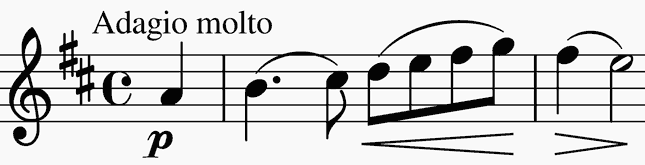 prepares us for the beautiful Adagio molto, whose opening theme is based on a rising figure that again embraces an interval of a fifth. The serenity of this idea is twice challenged by a threatening transformation in the minor, but serenity prevails.
There are more rhythmic tricks in the Finale. The rustic dotted theme starts with an accented up-beat which sounds like a down-beat as if the rustics are also tipsy. The movement is a Rondo with the opening episode alternating with a variety of others, including a “Quasi Trio” – compensation for the absence of a traditional Minuet/Scherzo & Trio movement.
Programme notes by Chris Darwin
Leoš Janáček (1854-1928) String Quartet No.2 (Intimate Letters) (1928)
Andante – Con moto – Allegro Adagio – Vivace
Moderato – Andante – Adagio Allegro – Andante – Adagio
The 27 year-old Janáček married his not yet 16 year-old pupil Zdenka in 1881. But his fervent patriotism did not sit well with her staid German background and the couple separated shortly after the birth of Olga their first child in the autumn of 1882. Two years later they reunited, and a son Vladimír was born in 1888, but died of meningitis in1890. Their relationship was further strained by the death of Olga in 1903 and by Janáček’s interest in other women. In 1916 he fell passionately for the assertive Gabriela Horvátová, who sang the part of the Kostelnička in the successful Prague production of Jenůfa. He took a holiday with her at the spa town of Luhačovice; his wife Zdenka attempted suicide and they went through a form of divorce. Around this time, Janáček also met at Luhačovice the art-dealer David Stössel and his 27 year-old wife Kamila Stösslová. Janáček fell for the strikingly beautiful Kamila, whom Zdenka saw as a useful ally against Horvátová; the couples visited each other and Zdenka corresponded extensively with Kamila. Janáček’s affections for Horvátová waned, Kamila kept Janáček at a distance despite his obsessively persistent correspondence to her (in all he wrote her over 700 letters), and his relationship with Zdenka improved. Kamila stimulated a burst of creative energy in Janáček: she is identified by him with the heroines in the song cycle The diary of one who disappeared, and the operas Káťa Kabanová, The Cunning Little Vixen and The Macropoulos Affair. His reputation soared.
In Easter 1927 Zdenka encouraged Janáček to visit the Stössels for a few days – she wanted him out of the house while it was redecorated – and during this visit his relationship with Kamila changed. Although their first kiss was not for another year, Kamila seems to have accepted his love and his letters now fantasize about her marrying him and bearing his child. It is this changed relationship which is the basis for his second String Quartet “Intimate Letters”. He writes to her that it was written “in fire” rather than the “hot ash” of previous compositions, and:
“Today at my place they (the Moravian Quartet) played our quartet Intimate Letters… I listen. Did I write that? Those cries of joy, but what a strange thing, also cries of terror after a lullaby. Exaltation, a warm declaration of love, imploring; untamed longing. Resolution, relentlessly to fight with the world over you. Moaning, confiding, fearing. Crushing everything beneath me if it resisted. Standing in wonder before you at our first meeting. Amazement at your appearance; as if it had fallen to the bottom of a well and from that very moment I drank the water of that well. Confusion and high-pitched song of victory: ‘You’ve found a woman who was destined for you.’ Just my speech and just your amazed silence. Oh, it’s a work as if carved out of living flesh. I think that I won’t write a more profound and a truer one.” John Tyrrell (trans & ed) “Intimate Letters” Faber & Faber 1994.
Their new relationship was short-lived. The next year, on an expedition together from a holiday cottage, the 74 year-old Janáček caught a chill which rapidly turned to a lethal pneumonia.
The viola part, at times representing Kamila, was originally written for the viola d’amore, but Janáček reassigned it to the viola to improve the texture of the quartet.
Programme notes by Chris Darwin