
As a vastly contrasting interlude between intensely original late quartets by the world’s two quartet masters of the classical period, 18 French minutes of string effects-driven sound exploration into the atmosphere of night signalled exciting instinctive and intelligently programming by the Castalians.
The Coffee Concerters, alert and prepared by Chris Darwin’s ‘Origins of the Pieces’ brochure notes, appreciated the rewards of the excursion offered. Without my English-French pocket dictionary, and not seeing any translation offered, I did not realise ‘Ainsi’ meant ‘Thus’ until I got home. So I and my fellow non-Francophiles missed the fullest experience of Dutilleux’s accomplished and meticulous sound depiction of human hours after dark.
Never mind. What I derived was vivid enough and I will now gravitate all the more towards a second hearing of Dutilleux’s only quartet, equipped as I now am by the Castalians’ deftly executed commitment to the cause.
It’s fascinating that it was a Frenchman who set one of the 20th Century benchmarks in effective experimental string composition and in 1976 it came 150 years after Beethoven died. Would the German have written like Dutilleux, Boulez or Messiaen if alive in their century? Or, born 100 years later than his 1770, would he have written like Debussy and Ravel? Would he have needed to have been French to share that sensuality?
Imponderable, of course, not least because Beethoven, deaf, would probably not have made enough substantial contact with the language of the effects Dutilleux was using, to draw them into his own language. The Castalians’ petite violist, Charlotte Bonneton, from Grenoble, told me later, much as she enjoyed playing French music new to her, Ainsi la Nuit was recently chosen for their repertoire by lead violinist Sini Simonen – a Finn.
Simonen has been a Castalian for four years and in several ways it is she who makes them remarkable. She is so subtly, so minimally demonstrative physically during her playing. There is no discernable intention to protrude, display or court attention.
The modern catch-phrase is “There is no ‘I’ in team”. Underlined afterwards when fellow fiddler Daniel Roberts told me any one of their four players can individually take the lead [in creating tempo or momentum, mood or atmosphere], or that any individual’s instrumental sound can become the prescribed focus of the three other quartet members to elevate the performance. One of the striking results is their transparency of sound and texture they achieve.
This young quartet is growing closer to the hearts of the Coffee Concerters in the footsteps of Heath Quartet and the Elias before them. With the charcoal stick, pencil, brush or ambient benefits of harmonics, plucks and slides – all channelled alongside standard tricks of tremolo, ponticello and mutes towards his subject of Night in previous experimental dry-run pieces – Dutilleux’s perfected sound painting in the Castalians’ hands evoked many commonly felt feelings, sensations, notions, agitations, delights and fears.
The movements are Nocturne, Space Mirror, Litanies and Litanies II, Constellations, Nocturne II and Suspended Time.
In his Opus 132, Beethoven was heading towards his own long night and writing about it subconsciously as well as otherwise. The Castalians played the second of his five Late Quartets, in which Beethoven transcends the music not only his own age but of all eras. The reason I still feel unqualified to examine in detail any group’s performance of these works was voiced for me by Charlotte Bonneton in our chat, which confirmed my sense that, whether listening or performing, we commune with Beethoven’s intensified perception of life’s fundamental unanswerables.
Bonnetton said, “Yes, it can take a lifetime to understand fully this music, and probably needs even longer than that.” After a performance of late Beethoven, many of the things she listed her quartet as feeling coincided with what we do as listeners. And the culminating one she listed was ‘nourishment’. For spiritual reward, we need late Beethoven on our dinner plates!
After his rarified main opening utterance of his slow movement, his declared hymn of thanksgiving for deliverance from serious stomach illness – yet another great highlight moment in Beethoven, the music stirs into new life. I flashed a look across the quartet at this point and saw one small, gentle smile. It was Benneton’s. Darwin tells us, we have wine, coffee and spices to thank for this music – or rather the composer’s obedience to his doctor’s orders to banish them.
Heading up this excellent concert programme was Haydn. Not familiar Haydn, nor Esterhazy Court everyday Haydn, but The Father of the String Quartet in his 65th year. In his following final 12, strength wilting under the weight of large scale commissions, he completed only two more of his 69 quartets. And the Castalians gave us, with complete assurance, true Late Haydn. Just like his pupil Beethoven: consummate fresh originality, daring and wisdom, all borne of long mastery and a thirst for remaining alive.
The Castalians return on 25 February to play another of Haydn’s twilight-years Opus 76 (No 5 in D), plus Britten’s No 2, and they bring Simon Rowland-Jones as second violist for Brahms’ Quintet No 1 in F Op88. Rowland-Jones is two generations the Castalians’ senior but, says Roberts, “He’s in his 60s. We simply met and got on really well. We’ll be playing the Brahms together in Edinburgh just beforehand.”
 is a sequence of ‘laconic phrases until the lilting expansive cadence of its final bars’ (Rosemary Hughes). Notice that each of the illustrated four initial phrases contains three notes of a rising scale. This scale motif is central to the whole quartet. Three variations at the leisurely Allegretto tempo follow before the starting gate is raised on an Allegro fugue which then metamorphoses into a final variation.
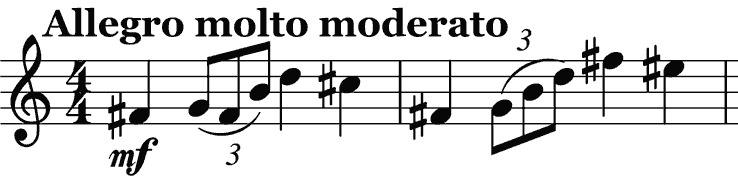
 Unlike Mozart who rarely strayed outside key signatures of 3 sharps or flats, Haydn was given to writing in lots of them. This movement is really in B major – 5 sharps, but it starts (illustrated) with no key signature albeit with the notes liberally sprinkled with sharps. Was this a riposte to complaints from his players about dreadful keys, or is the lack of key signature granting him licence for his upcoming fantastic explorations of the key-space? These explorations are facilitated by a series of four rising scales (echoing both the start of this movement and of the first movement) first on the violin and then on the cello. They lead the music off all around the block to Ab before a second lot of cello scales brings us home to B major and a proper key signature. The second half gives us a serene and poignant development of the theme.
 Four falling scales also make up the theme of the spirited final movement (illustrated).
 Dutilleux’s sound-world builds on his compatriots Debussy, Ravel and Messiaen but also includes Bartók and Stravinsky, with a preference for the modal and atonal over the simple tonal. Many of the quartet’s intriguing sounds are based on the opening six-note chord (illustrated) which particularly contains the intervals of the fifth (C#-G#, F-C) and the second (F-G, C-D). The seven short movements explore different string techniques: pizzicato, glissando, harmonics, very high and very low, very quiet and very loud. Dutilleux, like Sibelius, has in his own words “a tendency not to present the theme in its definitive state at the beginning. There are small cells which develop bit by bit”. So, see what you think and do talk about it in the interval.
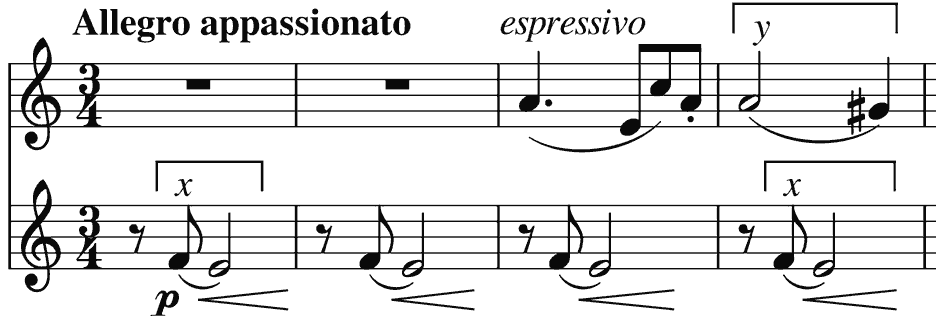
 (G#-A, E-F) in the cello’s opening phrase (illustrated), which is joined by the other three instruments playing variants of the same motif. This slow introduction is broken by rapid semiquavers from the first violin leading into an important motif (illustrated) which starts with one of the opening’s semitone pairs (E-F).
 The dotted rhythm (under y) provides a rhythmic engine to the movement and ends with the other semitone pair (G#-A).
 with the lines of a hymn (under x) interleaved by faster moving phrases. After the hymn, there is a dramatic change to the optimism of D major for a faster variation section marked “New Strength” in which the two violins dance around each other. A more syncopated version of the hymn returns followed again by a variation and finally by a yet more syncopated fantasia on the hymn marked “with the most intimate feeling”. The convalescent falls asleep with gentle sighs…
 to the first violin’s restless theme with its G#-A semitone (under y). A gentler theme with decorative trills brings some hope, but wild cross-rhythms augment the tension culminating in an anguished outburst high on the cello as the tempo hits Presto. But the key then shifts to a radiant A major, and the quartet ends in a mood of joyful optimism.
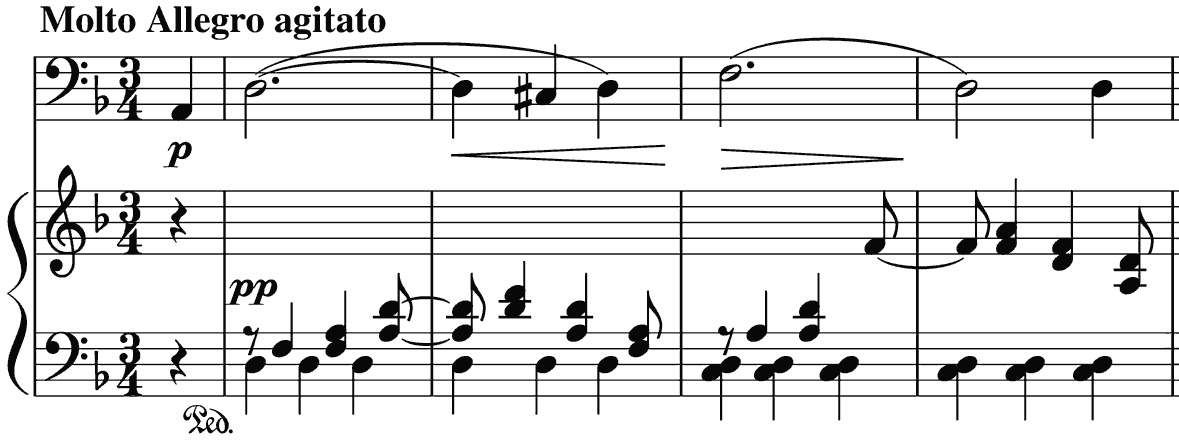 right hands of the piano’s accompaniment to augment the sense of agitation, pushing forward the gloriously expansive cello melody.
 The tenderness becomes more impassioned after the piano recalls a descending idea that the violin had used as a counter-melody in the first movement (illustrated).
 The last movement can’t compete for sheer tempo, but uses more traditional means: contrapuntal ingenuity driven by a fiendishly complex piano part, and then the cello bursting forth with the most gloriously optimistic theme of the whole wonderful work (illustrated).
 (illustrated). The tempo drops to Allegretto and the second theme recalls the opening Lento. The tempo changes again to yet another melody combining ideas from the two preceding ones. The movement continues to move pleasingly between these different tempi and their related melodies.
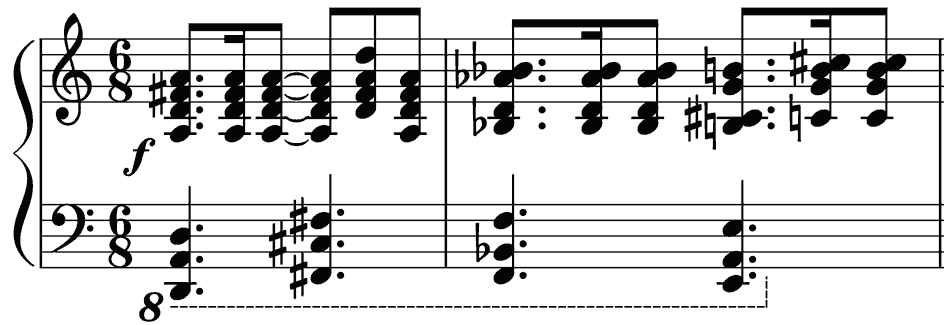 The last movement starts dramatically Lento then Andante with big chords reminiscent of Brahms before the piano plunges off into a hearty waltz-like Allegretto (illustrated). Numerous varied episodes at different tempi follow incorporating material from the preceding movements.
 The opening bar figures prominently in the development, while the third bar material (under x) yields a novel pizzicato dialogue between the two strings, an example of the new textures that Beethoven creates in this work. The opening of the Scherzo (illustrated)
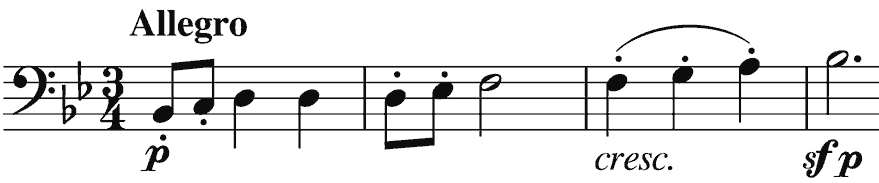 begins another string dialogue, using material related to that under x and y in the first example. Its lightness contrasts with the creepy gloom of the opening of the Trio.