

Frank Bridge (1879-1941)
Three Idylls for string quartet
Adagio molto espressivo
Allegretto poco lento
Allegro con moto
Born at 7 North Road Brighton, Bridge learnt violin with his violin teacher father and studied violin and composition at the Royal College of Music. He played violin and also viola, which became his favourite instrument, in various string quartets and also began conducting, sometimes deputising for Henry Wood.
Bridge dedicated the Three Idylls of 1906 to the Australian violinist Ethel Elmore Sinclair with whom he played in the 2nd violins of the RCM Symphony Orchestra. He married her in September 1908.
The first Idyll opens in minor mode with the main theme on the viola. Later a passage in the major provides a shaft of light with echoes of Debussy’s string quartet, a piece Bridge greatly admired. The opening returns, but now with all strings muted.
The second of the Three Idylls, which Britten used as the theme for his Variations on a theme of Frank Bridge for string orchestra Op. 10, is fairly short, and is followed by the third which introduces a light, rhythmic and more playful mood and some delightful exhilarating writing which then builds to an intense climax.
William Alwyn (1905-1985)
String Quartet No.1 in D minor
1. Moderato e grazioso
2. Allegro molto
3. Adagio
4. Allegro vivace
Alwyn, who was from Northampton, entered the Royal Academy of Music in London aged 15 where he studied flute, piano and composition. He later played flute for awhile in the London Symphony Orchestra and from 1926-55 served at the R.A.M. as Professor of Composition. In 1978 he was awarded a CBE.
His works include 5 symphonies, 4 operas, concertos for a variety of instruments, numerous chamber works including 3 string quartets and a huge number of film scores. His wartime film scores were considered to be so critical to boosting public morale that he was placed on a Nazi death list!
The first movement of his string quartet is passionate and intense despite its Moderato e grazioso label! The second is lively with a brief gentler episode soon after the opening, before the energy returns. The third movement open serenely, leading into a more poignant dialogue between the instruments. A little later, a very striking and beautiful passage is when over low gently pulsing chords a very high passage on the violin enters, gradually leading into a serene close. The fourth movement features a spiky and energetic rhythm, with a more poignant and reflective episode introduced by the viola, before a return of the opening.
Benjamin Britten (1913-1976) String Quartet No.3 Op.94 (1975)
I. Duets
II. Ostinato
III. Solo
IV. Burlesque
V. Recitative and Passacaglia (La Serenissima)
Britten’s compositions for string quartet fall into three groups that were written at very different times of his life: first, a number of early works from his teens (1928-33) which reflect his growing independence from his teacher Frank Bridge; then, his first two numbered quartets published in 1941 and 1945, around the time of Peter Grimes; and finally, this third quartet – one of his last works.
Britten’s health deteriorated through heart disease during the last decade of his life. He finished his final opera Death in Venice in the spring of 1973, and after celebrating its completion went into hospital to have a failing heart valve replaced. The operation was only partly successful, and also induced a slight stroke which affected his right hand. For the next year he composed nothing, and failed even to join in the celebrations of his own 60th birthday in November. With dedicated nursing care he gradually returned to composition, revising his third cello suite after a visit by Rostropovich in early 1974, and being encouraged by Donald Mitchell to revise his early unnumbered String Quartet in D for publication. Mitchell was a friend and biographer of Britten, first Professor of Music at Sussex University and co-founder with Britten of Faber Music. Further inspiration came to Britten from hearing Janet Baker, for whom he had composed the Rape of Lucretia, sing Berlioz’s Nuits d’été at the Aldeburgh Festival; this performance lead to his composing the dramatic cantata Phaedra for her.
The third quartet, though composed at around the same time as Phaedra, has close links with Britten’s Death in Venice. The quartet is dedicated to Hans Keller, a personal friend and tireless advocate of Britten, who co-edited with Donald Mitchell the influential New Series of the Music Review in the early 1950s. Keller wrote of the Third Quartet that here the composer had taken ‘that decisive step beyond – into the Mozartian realm of the instrumental purification of opera’. Keller was clearly a bigger fan of the string quartet than of opera (‘I never was an opera fan—about twenty-five musically supreme masterpieces in this curious medium apart’), but his comment captures the relationship between Britten’s opera and his quartet: the extremely spare writing of the quartet distills some of the essence of Britten’s opera and of its tormented protagonist Aschenbach.
Most of the quartet was written in a now Grade-II-listed potting shed at Chapel House in Horham, Suffolk where Pears and Britten moved in 1971 when Red House in Aldeburgh became too congested for composition. But the final movement was written in Venice itself on Britten’s last visit there in November 1975. Britten explicitly marks motifs from Death In Venice in the introductory recitative of the last movement, each player introducing a different one. Perhaps the most significant is that introduced pizzicato by the first violin,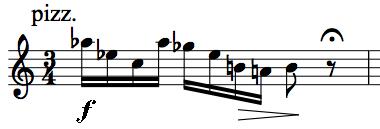 which is derived from Aschenbach’s tormented “Phaedrus aria”. Aschenbach reflects on his attraction to the beauty of the young boy Tadzio, which could be either unfulfillingly Platonic, or corruptingly Dionysian. Auden had famously written to Britten warning him against allowing the bourgeois to repress the chaotic bohemian in his personality. But Britten found it hard to “embrace disorder” and the tension shaped his life, health and music.
Britten heard a run-through of this third quartet by the Amadeus Quartet in the library of the Red House in Aldeburgh on 28 September 1976, but he died two weeks before the première at the Snape Maltings on 19 December.
Colin Matthews (b.1946)
String Quartet No. 6
1. Waltz-Mazurka 1
2. Quasi Gavotte
3. Gigue
4. Berceuse
5. Courante
6. Musette
7. Barcarolle
8. Waltz-Mazurka 2
Colin Matthews studied classics and then composition at Nottingham University. In the 70’s he taught at Sussex University where he received a doctorate for his work on Mahler, and also worked with Britten and Imogen Holst at Aldeburgh.
He collaborated with his composer brother David Matthews and Deryck Cooke on a performing version of Mahler’s 10th Symphony from 1964-75.
His large output includes many works for orchestra, two cello concertos, the second being written for Rostropovich in 1996, six string quartets, orchestrations of all of Debussy’s 24 Preludes and works for choir.
He was awarded an OBE for his services to music in 2011.
His 6th string quartet was completed in 2023 and dedicated to and first performed by the Gildas Quartet in June of 2025 at the Aldeburgh Festival.
The composer says of the eight movements ‘Their titles more or less speak for themselves, the intention being a Suite-like assembly of different moods, but all having the same kind of improvisatory feel’.
Programme notes by Chris Darwin (Britten) and Guy Richardson