

Omne trium perfectum
Willard Carter, Charlotte Saluste-Bridoux and Edgar Francis
This concert explores repertoire of European music from the seventeenth to the twentieth century. It gives a taste of developments in string techniques and also of chamber music written for the concert hall.
Dall’Abaco (1710-1805) Capriccio No. 1, 6 and 8
Dall’Abaco was born in Brussels where he received tuition from his father, a professional musician. Joseph took a position as cellist in the court orchestra in Bonn where he later became Kapellmeister. His rowdy behaviour and reputation as a swindler and gambler got him into trouble and he moved to Verona to start afresh. Here he became a member of the Academia Filarmonica and was well known as a cellist and composer.
These Capricci come from a set of eleven. Their style is reminiscent of Bach’s Cello Suites though these three are simpler in their linear progression with almost no use of chords at cadence points. Repetition of motifs is evident and the texture is that of continuous movement. A thoughtful performance which allows the music to speak for itself unadorned or encumbered with directions for dynamics is needed here and these Capricci are by no means simple exercises.
Kurtág (b.1926) Signs, Games and Messages: Doloroso, Parlando, Calmo, Sognando (Ștefan Romașcanu a memoriam) …féerie d’automne…
Kurtág is a Hungarian composer. Born in Romania he studied the piano and composition. He moved to Hungary in 1945 and enrolled at the Franz Liszt Academy of music. In 1967 he was appointed to the staff of the Budapest Academy of music, first as professor of piano and then in 1969 of chamber music.
Signs, Games and Messages is a collection of miniatures which was begun in 1961. The pieces are musical aphorisms and they are variously technical experiments dedicated to friends and memorials for colleagues and other artists. There are often more words for performance instruction than musical notes.
C F Abel (1723-1787) Arpeggio in D Minor
Abel was a German composer and Gamba player who was renowned in Dresden where he was director of music in 1743. He came to London where he became a chamber musician in the court of Queen Charlotte in 1764. With J C Bach he founded a series of subscription concerts.
Manuscripts of Abel’s Gamba pieces were found in a library in Poland having been taken there from London by Count Joachim Carl of Maltzan. In 2023 a new catalogue of Abel’s works was made.
JP von Westhoff (1656-1705) Imitatione delle Campane
Westhoff was a German composer and violinist who worked in Dresden. He also worked at the Weimar court and in addition to so much music, he taught contemporary languages. Westhoff’s compositions were a strong influence on the work of J S Bach who was his contemporary in Weimar. The Imitatione delle Campagne is an arrangement from his solo Violin sonata n.3.
Zbinden (1917-2021) La fête au village:Fanfare
Zbinden was a Swiss composer and jazz pianist who studied in Geneva. He worked at Radio Suisse de in Lausanne as a recording manager and later as head of the music department. He received honours and many prizes and as a composer of stage works, chamber pieces and five symphonies had a distinguished career. Zbinden’s music is influenced by Arthur Honegger and neoclassicism and is jazz inflected. La fête au village: Fanfare can speak for itself!
Boccherini (1743-1805) Trio in A Major, Op.14
Boccherini was a composer and Cellist who was born in Lucca, Italy. He studied the cello in Rome and in 1757 he went to Vienna where he and his father worked as musicians in the Burgtheater.In 1768 Boccherini moved to Madrid and worked under royal patronage. Later he worked for King Friedrich Wilhelm II of Prussia who was an amateur cellist, flautist and a patron of the arts.This trio written in 1772 has four movements: Allegro moderato, Largo, Allegretto smorfioso (simpering/affected) and Minuetto.Boccherini’s music is characterised by his liking of syncopation and the placing of slurs that throw the phrasing off balance. For much of his life he worked in isolation and his style is unaffected by others of his period. There is a fundamentally suave aesthetic and a lightness that ensures his place in what we now call the rococo period.
Penderecki (1933-2020) String Trio
Penderecki was Polish and he studied at the Academy of Music in Kraków, graduating in 1958. He subsequently taught there and it was then that his well known piece Threnody to the victims of Hiroshima was written. In the 1970s Penderecki moved to Yale School of Music in the USA. During his lifetime he won many awards and he is one of Poland’s best known composers. His influence is wide and much of his music can be heard as film soundtracks.
Penderecki’s string trio has two movements: Allegro molto and Vivace. In both movements there is a preponderance of solo writing which is interrupted by jagged chords from one or both remaining instruments. The intensity is sustained throughout and the overall aesthetic is that of its time. There is less need for comforting lush melodies and more for direct communication however harsh it may seem at first hearing.
W.A. Mozart (1756–1791) Divertimento for String Trio in Eb K.563 (1788) Allegro
Adagio
Menuetto: Allegretto Andante
Menuetto: Allegretto Allegro
The start of the Austro–Turkish war in February 1788 was not good for Mozart‘s fortunes. Food prices rose and many aristocratic families fled Vienna to avoid conscription. His finances were already strained and he was apparently unwilling to economise on a lifestyle developed in better times – a spacious apartment, horse and carriage. The kindness of Michael von Puchberg made things easier for Mozart. Puchberg was a textile merchant, amateur violinist and fellow freemason who responded generously to Mozart‘s increasingly desperate pleas for financial help. In acknowledgment of this magnanimity Mozart wrote the K.563 Divertimento for Puchberg. It was finished in September 1788 and first performed in April 1789 in Dresden where Mozart was en route to Berlin in search of royal commissions, hitching a ride from Vienna with Prince Karl Lichnowsky. Mozart himself played viola in the performance.
The work is one of the first for the combination of violin, viola and cello, and has a depth and intensity that goes beyond previous Divertimenti, although it preserves their typically 6-movement form. Ten or so years later it provided a model for Beethoven’s masterly six–movement Op 3 Divertimento also in E-flat and his subsequent three wonderful Op 9 string trios.
On casual listening to this remarkable work, few people would notice that there were just three rather than the more usual quartet of string players, and this is achieved without Mozart resorting to double stops except on a bare handful of occasions. To achieve this harmonic and contrapuntal richness, the viola is worked harder than in a typical quartet, but is rewarded by the thought of sitting beside Mozart revelling in the wonders of his writing.
The opening could not be simpler: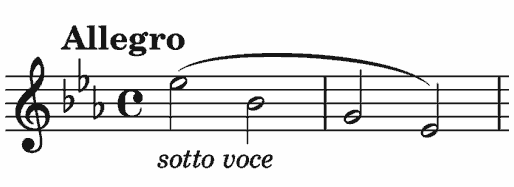 a unison descending arpeggio in minims in the home key of E-flat (illustrated). Yet it provides thematic material for the whole work, most immediately as a faster rising arpeggio two bars later and then as a yet more rapid rising scale in bar 6. The sonata form first movement elaborates these motifs along with a contrasting second subject. Although Mozart rarely composed works in remote keys, the start of the development section shows the ease with which he can modulate briefly into the remotest of keys, here demanding an E-sharp of the viola – a note previously unplayed by this amateur violist!
The arpeggio rises in the cello’s opening of the A-flat major Adagio second movement and is immediately elaborated by the violin. Again the development explores the outer reaches of keydom (an F-flat this time!) with Mozart perhaps revelling in the challenge of convincingly negotiating extreme harmonic changes with only three parts.
Falling arpeggios again make up the theme of the third movement‘s Menuetto (illustrated) with a contrasting upwards creeping and then sliding down figure in its Trio.
The following Andante is a very substantial movement and an interesting take on Theme and Variations. The first 8 bars of the theme are followed by a variation on them, then the second 8 bars of the theme are followed by their variation. This pairwise pattern is repeated twice more before the sombre sixth variation in the minor leads us back into the major and a completely different sort of variation. The violin (demi-semi-quavers) plays twice as fast as the cello (semi-quavers) while the viola rather smugly plays a very leisurely skeletal version of the theme before taking over the violin’s demis and then handing them on to the cello. The movement ends with violin and cello playing the first two bars of the theme in canon.
The last movement is a rollocking rondo (with the viola working hard on accompanying arpeggio triplets) with which Mozart brings to a triumphant end what Alfred Einstein called “one of his noblest works”.
Programme notes by Chris Darwin (Mozart), Andrew Polmear (Dall’Abaco) (adapted) and Helen Simpson