

15th February 2026 – Elmore Quartet – Programme notes
Josef Haydn (1732-1809) String Quartet in D, Op.76 No.5 (1797)
Allegretto
Largo ma non troppo. Cantabile e mesto
Menuetto. Allegro
Finale. Presto
In 1795 Haydn returned from his spectacularly successful visits to England to the relatively light duties prescribed by the new Esterházy Prince Nikolaus II. Nikolaus had abandoned his father’s palace at Esterházy, sacked its extensive musical establishment, and divided his time between Eisenstadt and Vienna. Haydn was kept on, but his main duty was just to write a Mass for the Princess’s name day. He was free to accept other commissions. One such came from Count Joseph Erdödy, the Hungarian Court Chancellor.
Although Erdödy’s father had employed an orchestra to play in their family’s three palaces, on inheriting the title in 1789 his son responded both to contemporary taste and financial stringency by replacing the orchestra with a string quartet. In 1796 he placed a generous commission with Haydn for six quartets. The resulting ‘Erdödy’ quartets are a triumph, perhaps the pinnacle of Haydn’s long quartet-writing career.
The overall form of the fifth quartet is unusual, as one might expect from Haydn – the genre’s creator. Quartets usually have a first movement that is in sonata form; the middle movements tend to be a slow movement, which may be a set of variations or something more rhapsodic, and a minuet or scherzo. The final movement is often a fast movement in rondo form with a theme returning after each of a variety of sandwiched episodes. In this quartet though the first movement is a series of variations on a siciliano theme, the slow movement and the last movement are in sonata form, and only the Minuet obeys the rules.
The opening themes of the second and third movements (both illustrated) are closely linked: they start with the same sequence of four notes (under x & y) – a rising triad in the home key starting on the dominant.
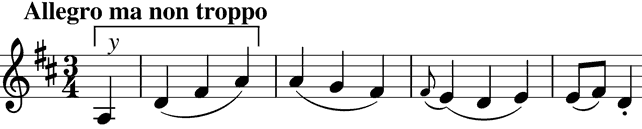 The Largo slow movement starts on an upbeat C# on the violin which you might think would lead into the home key of D; but no, this is Haydn and it turns out we are in F# major – the sharpest key signature in all his chamber music. After a pause, the slow movement continues with what Hans Keller described as ‘the deepest viola solo in all Haydn’ accompanied by the violins’ ethereal linked quavers. The cello takes over and leads us gloomily down through semitone modulations to pause again, now, briefly, in the even sharper C# major. The violin recaps the theme in the home key, lifting the clouds.
Notes by Chris Darwin
Bela Bartok (1881-1945)
String Quartet No.3 (1927)
Prima parte – Moderato: Seconda parte – Allegro: Ricapitulazione della prima parte – Moderato: Coda – Allegro molto
Bartok’s 3rd quartet is the most intense and concentrated of his six string quartets and the only one in a continuous movement, but divided into four sections, as marked above.
It is also his shortest quartet, but within its c.16/17 mins. he packs an amazing range of moods and styles.
Its first performance was in 1928 and won joint first prize with a quartet by Alfred Casella in the string quartet competition of the Musical Fund Society of Philadelphia.
Bartok named Bach and Beethoven as two of the composers he’d learnt most from. The influence of Bach you can hear in the intricate contrapuntal writing, and of Beethoven in the development of the whole piece from a few short motifs announced at the beginning, after a very short introduction.
The work displays the astonishing imagination of Bartok’s sound world.
The range of emotions and styles includes passages of intensely expressive writing, some brief examples of Bartok’s night-music with its mysterious, slightly spooky atmosphere, percussive and aggressive outbursts (which make punk sound positively tame), and exciting, vigorous elements of dance.
The piece is fundamentally an intimate conversation between the four instruments, and includes many canons and fugues and a wide variety of instrumental techniques, including several passages using glissando slides, sounding like sighs or questions.
There are moments of great delicacy and playfulness, and moments of a wonderful stillness, where the music seems to take a deep breath, before launching into further dialogue.
The emphatic final notes sound like a unanimous agreement amongst the four different voices.
Notes by Guy Richardson
Ludwig van Beethoven (1770-1827) String Quartet in E♭ Op. 127 (1825)
Maestoso – Allegro
Adagio, ma non troppo e molto cantabile – Andante con moto
Scherzando vivace
Finale. Allegro
Beethoven’s last three years (1824-7) were predominantly occupied in composing what we now refer to as his late string quartets: Ops 127, 132, 130, 131 and 135. In November 1822, it had been 12 years since he had completed a quartet – the F minor Op 95 Serioso. He had made sketches for another quartet and indeed in the summer of 1822 the publishers Peters turned down an offer of a string quartet, but his interest in quartet writing might never have seriously revived had he not had a commission for “one, two or three quartets” from Prince Nicholas Galitzin, an excellent young amateur cellist from St Petersburg. The commission almost went to Weber, whose recent opera Die Freischütz, had excited Galitzin; but fortunately Karl Zeuner, the viola player in Galitzin’s own quartet, nudged him towards Beethoven instead. Ignaz Schuppanzigh, the leader of Beethoven’s preferred quartet, was visiting St Petersburg around that time and might also have contributed to Beethoven getting the commission. Completing the Missa Solemnis and the Ninth Symphony occupied Beethoven for another eighteen months, but he finished three quartets for Galitzin, Ops 127, 132 and 130, in February, July and November of 1825.
The Op 127 quartet reflects Beethoven’s more genial and productive state of mind following the difficult years of the mid-1810s. Like the Hammerklavier sonata of 1818 it carves out radically new musical paths. The first performance by Schuppanzigh’s quartet in 1825 was a failure and another a few weeks later with a different leader fared little better. It was only after players and audience alike had grown more accustomed to the music that it was appreciated by more than a small group of enthusiasts and Beethoven felt he could report to his publisher Schott’s that “People have a high opinion of the quartet. It is supposed to be the greatest and most beautiful quartet I’ve written, so they say…“.

The key of E-flat major for Beethoven is associated with grand gestures, and the opening of this quartet recalls the opening of the Eroica Symphony and the Emperor Concerto. We are in a serious and mysterious world. But after a mere six bars Maestoso gives way to Allegro, piano e dolce, teneramente (tenderly) – early sketches were even headed “la gaieté”, perhaps in contrast to “La Malinconia” (melancholy) in the last of the Op 18 quartets. However, the Maestoso opening and its two reappearances warn us not to be deceived into thinking that this is an altogether light-hearted quartet.
Its depth is clear in the extensive slow movement: a set of six wonderful variations. The slowly syncopated, pulsing cello starts the build-up of a dominant seventh chord from which the first violin sings the long theme. The first variation disturbs the serenity of the theme with a faster tempo and increased syncopation. Then the music speeds up again to Andante con moto and the two violins gambol above a persistent staccato accompaniment from the viola and cello. The gambolling eventually fades and the fourth variation dramatically shifts key from 4-flats to 4-sharps via a favourite Beethoven trick of simply sliding up a semitone (*) from C to C#, as if he needs to be in E major so he just goes there by the shortest route. The tempo changes too, to a slow two-beat Adagio molto espressivo, for a variation of the utmost serenity. At the end of the variation, the lower instruments pulse the new time, and the first violin returns us to 4-flats as we left it, with a (now downwards) semitone shift. The first violin and cello share an ecstatic duet, alternating the theme with accompanying arpeggios and trills. The final variation consists of a stream of semiquavers, initially in the first violin, but then enriched in the three lower parts. The music suddenly stops for a full half bar, pulsing quavers start and the first violin leads us to the end of our visit to a new and strange world.
The Scherzo’s complex rhythms contrast with its hurtlingly fast trio. Again Beethoven plays with halting the music abruptly, fooling us into thinking that we are in for a second dose of trio, before abruptly calling a halt. For most of the Finale, we are entertained by genial and at times rustic music, but towards the end, the metre changes, and the main theme undergoes an unearthly transformation against rapid triplet semiquavers. Beethoven opens a door back to the serious and mysterious world of the slow movement, where he leaves us.
Notes by Chris Darwin