
 Maurice Ravel 1875-1937 ‘Le Tombeau de Couperin’ for Piano (1918)
Arranged for wind Quintet by Mason Jones (1919-2009)
Prélude. Vif
Fugue. Allegro moderato
Menuet. Allegro moderato
Rigaudon. Assez vif
Musically, ‘Un Tombeau’ is a piece written in memory of someone. Ravel’s original six movement piece for piano is patriotically titled as being in memory of François Couperin (1668-1733), who established a distinctively French keyboard style of composition; but each of the movements is also dedicated to the memory of a different close friend killed in the first world war. When war broke out Ravel was working on his piano trio, the symphonic poem La Valse and a few other projects including Le Tombeau. He completed the piano trio in five weeks and then volunteered for service. His several attempts to enlist as an aircraft pilot were turned down on health grounds, but he finally became a driver in the motor transport corps. Despite the death in January 1917 of his mother, who was perhaps the only person to whom he was emotionally attached, Ravel finished the six pieces of Le Tombeau and planned to perform them. When bombing postponed the initial performance, Ravel used the time to create an orchestral version of four of the original six movements.
Notes by Chris Darwin.
Sally Beamish b1956
Adagio and Variations after Mozart, for Flute, Cor Anglais, Clarinet, Horn and Bassoon (2011)
Sally Beamish studied Viola and Composition at the Royal Northern College of Music where her composition tutors were Anthony Gilbert and Lennox Berkeley. She has written chamber music, symphonies and concertos. In 2020 she was awarded the OBE for services to music. Sally Beamish now lives in Sussex.
The New London Chamber Orchestra asked Sally Beamish for an arrangement of Mozart’s Adagio for glass harmonica, flute, oboe, viola and cello (K617). She wrote “I wanted to try to capture some of the strange beauty of the instrument. I used cor anglais…to give a warm, dark quality to the quintet – when I’d finished I had the impulse to launch into a set of variations and here I cast each of the five instruments in turn as a soloist, sometimes with a duo partner. The Adagio theme returns at the end with each player adding a fragment from its own version”.
Notes by Helen Simpson
Grażyna Bacewicz (1909 – 1969)
Wind Quintet (1932)
Allegro
Air. Andante
Allegretto
Vivo
Grażyna Bacewicz was born in Poland. Her father was Polish and her mother Lithuanian. Her musical tuition began at home and continued at the Warsaw Conservatory with violin and composition studies. Her composition tutor was Nadia Boulanger. During the occupation of Poland Bacewicz and her family were in Warsaw where she wrote to her brother “the situation is spiritually dire”. Nevertheless she continued to compose and perform with friends. Later, in 1956 the Warsaw Autumn Festival featured three of Bacewicz’s compositions.
The quintet to be played today won the First Prize in the Concours de la Société “Aide aux femmes de professions libres” Paris 1933.
Allegro. This is cheerful, light and athletic. All five parts are equally important and they pass the motifs around freely.
Air. Andante. A more reflective mood is shown here and as in the first movement this is moving towards atonality.
Allegretto. A bright folk-like melody is worked over here. It is a controlled rendition and not overly rustic.
Vivo. This, like the opening movement, shows her witty light touch and the elegant instrumental lines now draw the piece to a close.
Notes by Helen Simpson
Krzysztof Penderecki (1933 – 2020)
Prelude for Solo Clarinet (1987)
Penderecki was Polish and he studied at the Academy of Music in Kraków, graduating in 1958. He subsequently taught there and it was then that his well known piece Threnody to the victims of Hiroshima was written. In the 1970s Penderecki moved to Yale School of Music in the USA. During his lifetime he won many awards and he is one of Poland’s best known composers. His influence is wide and much of his music can be heard as film soundtracks.
The Prelude for Solo Clarinet was given to the British composer Paul Patterson on his 40th birthday. The first performance was given in Manchester in 1987. It is improvisatory in character and is written with no bar lines. However one can discern the A B A structure with the middle section’s chromatic runs and trill – like thirds which contrast with the sparseness of the opening and closing sections.
Notes by Helen Simpson
Carl Nielsen (1865-1931)
Quintet for Flute, Oboe / Cor Anglais, Clarinet, Horn & Bassoon Op 43 (1922)
Allegro ben moderato
Menuetto
Praeludium: Adagio. Tema con variazioni: Un poco andantino
Carl Nielsen was the seventh of house painter and amateur musician Niels Jørgensen’s 12 children. Why Nielsen rather than Jørgensen? Although the Danish aristocracy had long used hereditary surnames, many ordinary Danes stuck with the old patronymic system until the late 19th century. Carl followed his father in playing the violin and cornet, and composed from the age of 8. But his family did not encourage him to study music, apprenticing him aged 14 to a shopkeeper, who fortunately went broke almost immediately. Carl then became an army bugler and trombonist, and composed some works for brass ensemble. He was introduced to the composer Niels Gade, Professor at the Copenhagen Conservatoire, who took to the young man, and at 19, Nielsen began studying with him. After graduation, Nielsen taught violin and also played violin in the Royal Danish Orchestra.
Although he is now best known for his concertos and his six symphonies, in which brass instruments figure prominently, he also wrote some chamber music, most notably four string quartets and today’s wind quintet.
The quintet is a relatively late work and was inspired by a phone call to a pianist friend who happened to be rehearsing the Mozart Sinfonia Concertante with four wind players. The piece was written very much with those overheard individuals in mind; it reveals the personalities both of the instruments and of the players, sometimes alone, more often in conversation or argument. The work is genial and entertaining, often with a Poulenc-like playfulness.
The last movement is the most complex. Like the last movement of Mozart’s Sinfonia Concertante, it is a set of variations. They are introduced by a short Prelude in which each instrument makes a cadenza-like statement – the oboe being replaced briefly by the cor anglais.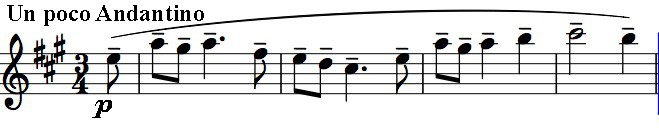 The variations are based on Nielsen’s own chorale tune ‘My Jesus, make my heart to love thee’. He describes them as ‘… now gay and grotesque, now elegiac and solemn, ending with the theme itself, simply and gently expressed.’ The reprised theme, marked Andante festivo, is in the more choraley 4/4 time rather than the opening version’s 3/4 – a joyfully serious end to a warm-hearted piece.
Notes by Chris Darwin.
Wolfgang Amadeus Mozart (1756 – 1791)
La Ci Darem La Mano, Duettino from Don Giovanni, Act 1 (1787)
Arranged for Wind Quintet by Raj Bhaumik (b2004)
Raj Bhaumik the Clarinetist in this quintet has arranged the very well known seduction aria sung by Don Giovanni to Zerlina. Mozart sets the Don’s teasing words and Zerlina’s responses that offer little hesitation and which accelerate the departure of the pair off stage for further persuasion. Lorenzo Da Ponte’s text for the opera takes the well known archetype and in this duet he shows that Zerlina is fully in control and through her repetitions and extensions of the Don’s phrases she confidently tells him what he wants to hear. Today’s instrumental arrangement of the aria will demonstrate this personal interplay despite there being no words in the performance.
Notes by Helen Simpson
 The violin gets to state the second theme (illustrated) whose opening (under x) is reused in the second movement. Towards the end of this genial and boisterous first movement Beethoven plays the false-ending trick – one that Haydn loved – before a long and novel final coda.
 The Adagio slow movement is, unusually in a rondo form with the opening material (illustrated) alternating with new ideas. Its start (under y) has an obvious relationship to the x passage of the first movement.
 the Scherzo we arrive at the boisterous Presto Finale which opens with a provocatively playfully jump of a tenth. More provocations follow – a slithery semitone descent perhaps cocking a snook at Mozart’s chromaticisms leading into a parody of Haydn’s Gypsy Rondo style. But the best is yet to come. After some daring modulations, the strings try to tip-toe away in a slow pianissimo semitone descent, but the piano leaps out at them blowing a giant raspberry (illustrated) and then skips away as if nothing had happened.
 The difference is evident from the start: the work opens with the violin and cello playing the expansive main theme (illustrated) in octaves treating them as a single voice against the piano. In fact, all the other movements also open with the strings in octaves. Despite the increased power of the 1880s piano, and Brahms’ proclivity for dense chording, it is important to bear in mind that the Streicher piano that he was then composing at was considerably lighter in sound than a modern Steinway concert grand: “to hear Brahms’s music on an instrument like the Streicher is to realize that the thick textures we associate with his work, the sometimes muddy chords in the bass and the occasionally woolly sonorities, come cleaner and clearer on a lighter, straight-strung piano. Those textures, then, are not a fault of Brahms’s piano composition.” (Edwin Good).
 Half-way through the movement Brahms plays a master stroke, the tempo notches up animato and the cello transforms the jauntily dotted opening phrase by slowing it in a heartfelt espressivo (illustrated) above ripples on the piano.
 A further modification of the opening gives the theme for the variations of the second movement. The rising third (now A to C) is still there, but the original dotted rhythm is reversed into a ‘Scotch snap’ (as in ‘body coming through the rye’).
 the end of the theme Brahms pulls a cunning technical trick: the two halves of the last 7 bars (illustrated) consist of a phrase followed by its inversion (rising intervals replaced by downward and vice versa). Such devices reflect Brahms’ thorough classical schooling (inversion of fugue subjects was a favourite baroque device), but using inversion to complete a melody looks forward, and perhaps contributed to Schoenberg’s famous view of “Brahms the Progressive”.
 again starts with string octaves with the hallmark rising third, but this time in a fleeting pianissimo in C minor. It is gloriously contrasted in the slightly slower trio section by one of Brahms’ wonderful soaring melodies (illustrated) back in C major.
 octaves and a rising third again start off the playful Finale – Allegro giocoso. The piano accompanies with a descending figure of repeated quavers (illustrated) which is extended and frequently recurs as a sort of laughing motif throughout this good-natured movement.
 he opening two bars have the second violin simply setting the A-minor key but with the viola and cello providing an underlying threatening tremble. The first violin provides the theme (illustrated) which recalls one of Schubert’s songs ‘Gretchen at the Spinning Wheel’: “My peace is gone, My heart is sore, I shall find it never and nevermore”.
 Two motifs shape the ensuing Allegro: it opens with a simple cadence (illustrated under 1), which after about 40 bars of tentative exploration leads to a joyful main theme as we finally get to the home key of C major (illustrated under 2). Only Beethoven could make such a movement out of these snippets.
 contrasts with its assertive Trio in which the viola and second violin (written with Razumovsky in mind?), egged on by the others, lift the semiquaver runs of the Menuet and show just how far they can take them.
 to give the start of the last movement’s fugue (illustrated). The viola, fresh from its triumph in the Trio, kicks off at speed for ten bars. Nobody is to be outdone, especially the first violin, who initiates a string-climbing competition, cheered on by the others. Finally, the second violin transforms the underlying slow accompanying figure into a lyrical vote of thanks and the party ends in a triumphant last fling.